
 Latest:
Whether you’re a supplier or an educator, find out what it means to be Backed by BESA Read more
 Strengthening Academic Differentiation in UK Independent Schools: A Scalable Research Infrastructure Model
Strengthening Academic Differentiation in UK Independent Schools: A Scalable Research Infrastructure Model
Published
Thursday, 26 March
Categories
Share
Prepared by GEC Academy, Dr Ran Li, FRSA, FHEA, CMgr, FCMI
Member of the British Educational Suppliers Association (BESA)
The UK independent school sector continues to enjoy a strong global reputation for academic excellence. However, the university admissions landscape has become significantly more competitive, particularly for highly selective institutions within the Russell Group.
For many schools, the strategic challenge is no longer how to improve examination performance, but how to demonstrate meaningful academic distinction beyond predicted grades.
Admissions tutors increasingly emphasise evidence of:
- intellectual curiosity
- independent research capability
- analytical reasoning
- engagement with academic ideas beyond the school syllabus
This shift presents a strategic challenge for schools.
This short white paper proposes that structured research provision should be understood not simply as enrichment but as a scalable component of Sixth Form academic infrastructure. When implemented effectively, structured research frameworks can strengthen supercurricular engagement, develop independent research capability, enhance analytical writing and support university admissions preparation.
For school leaders and governors, structured research represents an emerging category of academically rigorous provision capable of strengthening both student outcomes and institutional positioning.
1. The Changing University Admissions Landscape
- Increasing Competition in UK University Admissions
Recent data from UCAS indicates that competition for places at the UK’s most selective universities continues to increase.
In the 2025 UCAS admissions cycle, a total of 577,725 undergraduate applications were submitted, representing a 2.3% increase compared with the previous year. Applications to high-tariff universities increased by 6.9%, reflecting strong demand.
The Russell Group now accounts for approximately 29% of all UK undergraduate enrolments, up from 27% in the previous year. International demand also remains strong. In 2025, 124,830 international applicants applied through UCAS, with applications from China increasing by around 10%.
At the same time, academic attainment among applicants continues to rise. The proportion of A* grades awarded at A-level increased from 8.9% in 2023 to 9.4% in 2025, while the proportion of A grades increased from 18.3% to 18.9%. Combined A*–A attainment rose from 27.2% to 28.3%.
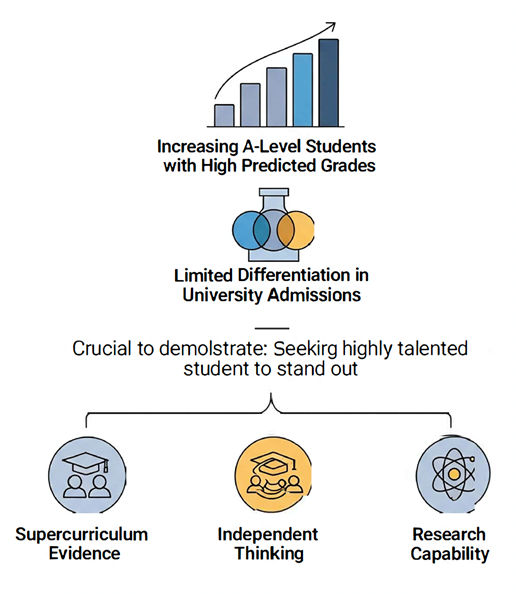
- Large numbers of applicants now present top predicted grades, making differentiation more difficult.
- There has been a long-term trend of a widening gap between predicted and achieved grades. In 2024, around half of UK 18-year-olds were predicted AAA or above, but only 26% of accepted applicants actually achieved these grades.
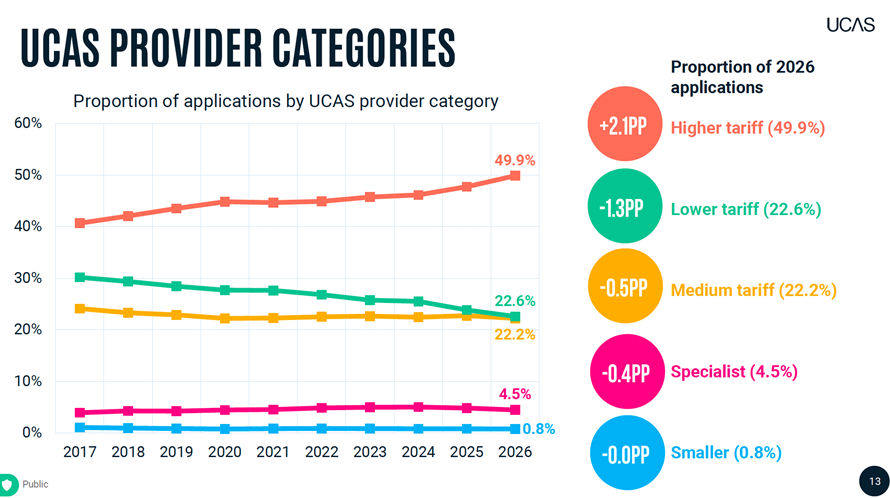
The higher-tariff provider accounted for 49.9% of the 2026 applications, representing nearly half of the total and showing the only upward trend among all providers.
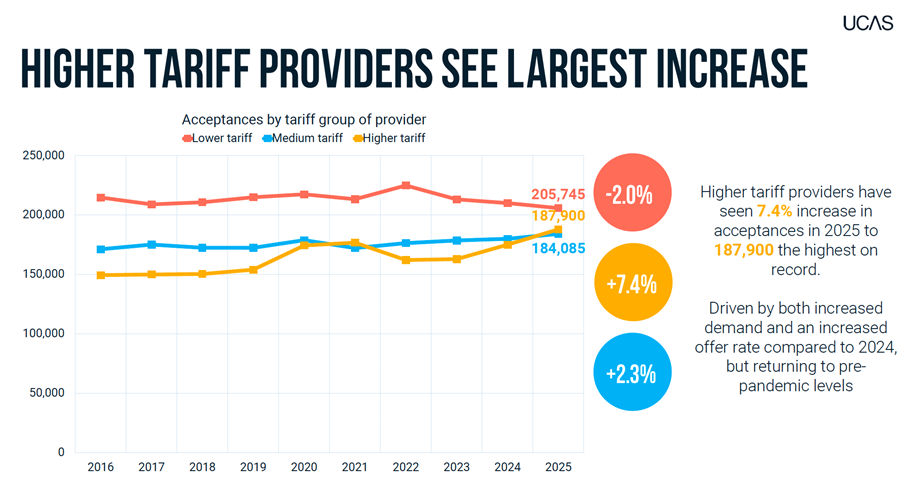
The growth in acceptances by tariff group is largely driven by higher-tariff providers. In 2025, acceptances increased by 7.4% to a record high. This suggests that although overall acceptances are rising, students are increasingly targeting higher-tariff universities, making admissions even more competitive for Sixth Form students.
- What Selective Universities Are Looking For
Guidance from the Russell Group highlights the growing importance of academic engagement beyond the school curriculum.
In its guide Informed Choices, the Russell Group notes that universities are interested in evidence that applicants have engaged with their subject beyond the classroom.
Examples:
- independent academic reading
- essay competitions
- subject-based projects
- academic lectures or seminars
- independent research exploration
These activities are often described as supercurricular engagement — academic exploration closely related to a student’s intended university subject.
Admissions tutors frequently emphasise that personal statements and interviews should demonstrate intellectual curiosity and genuine engagement with academic ideas, rather than simply listing achievements. Selective universities increasingly seek applicants who demonstrate intellectual independence and sustained engagement with their subject beyond the school syllabus.
Research by the Sutton Trust suggests that schools play an important role in supporting university applications and that opportunities for academic enrichment can strengthen students’ personal statements and preparation for selective universities.
- Implications for Schools
For many UK independent schools, progression to Russell Group universities and Oxbridge remains an important measure of Sixth Form outcomes. As competition increases, schools are increasingly seeking ways to support students in demonstrating both strong academicattainment and deeper intellectual engagement.
Providing opportunities for academic exploration beyond the curriculum—including research-based learning and subject-specific enrichment—can help students develop the confidence and analytical skills valued by selective universities.
2. Structural Pressures Facing Independent Schools
Independent schools operate within a complex landscape shaped by parental expectations, competitive positioning and regulatory oversight.
School leadership teams must balance high academic standards with staff workload pressures, safeguarding requirements and procurement due diligence.
As a result, any additional academic provision introduced into the Sixth Form must satisfy three essential criteria: academic credibility, operational simplicity and compliance with safeguarding and quality assurance standards.
Provision that increases marking, supervision or timetable complexity for teaching staff is unlikely to be sustainable in the long term.
3. Structured Research Provision as an Academic Category
Structured research programmes differ from traditional enrichment activities. Instead of offering additional experiences, they provide a formal framework for academic inquiry.
Typical programme elements include:
• research methodology training
• supervised independent inquiry
• structured academic writing
• presentation or defence of research findings
Such programmes are designed to complement existing initiatives including the Extended Project Qualification (EPQ), Oxbridge preparation programmes and subject extension activities. When integrated effectively, structured research frameworks can strengthen existing Sixth Form academic structures while introducing measurable academic outputs.
4. Implementation Model for Schools
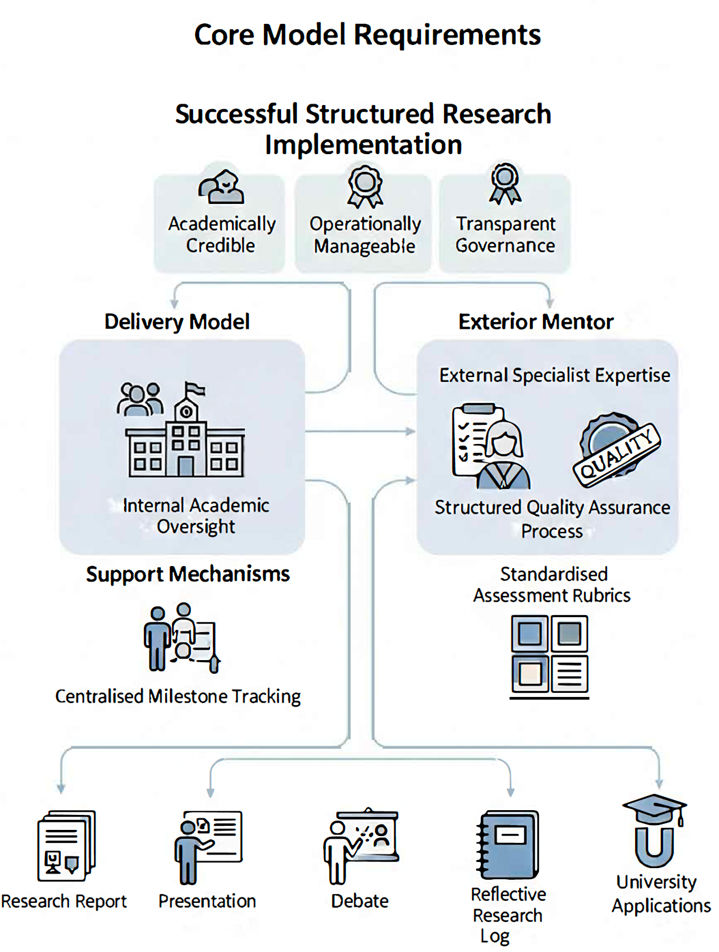
Successful implementation of structured research provision requires a delivery model that is academically credible, operationally manageable and transparent from a governance perspective.
Many schools adopt a model that combines internal academic oversight with external specialist expertise, including subject-specialist mentors and structured quality assurance processes.
Centralised milestone tracking and standardised assessment rubrics allow schools to maintain academic rigour without increasing internal supervision demands.
Students typically produce clearly documented academic outputs including a research report, presentation or debate and a reflective research log. These outputs provide tangible evidence of intellectual engagement that can support university applications.
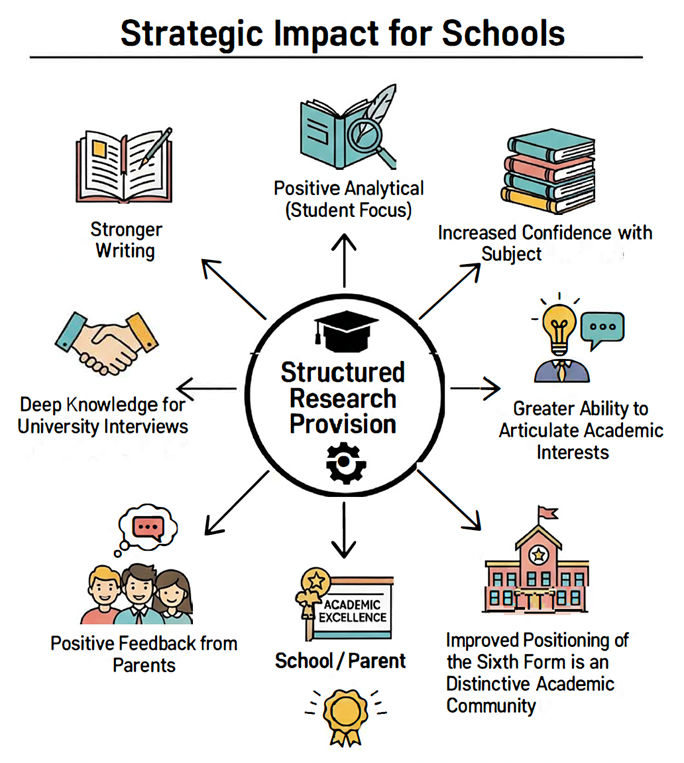
5. Strategic Impact for Schools
Schools implementing structured research provision frequently report improvements in analytical writing, student confidence in university interviews and the overall depth of personal statements.
Students often demonstrate:
• stronger analytical writing
• deeper engagement with subject literature
• increased confidence during university interviews
• greater ability to articulate academic interests
In addition to student outcomes, schools often report positive feedback from parents and improved positioning of the Sixth Form as an academically distinctive environment.
6. Procurement Considerations for School Leaders
When evaluating structured research provision, school leaders and governors typically consider several key factors including academic credibility, safeguarding compliance, operational simplicity and cost predictability.
Delivery by academically qualified mentors with higher education experience is often an important indicator of programme quality.
Transparent per‑student cost structures and minimal timetable disruption support procurement confidence.
For many institutions, structured research provision represents a medium‑term investment in academic infrastructure rather than a short‑term enrichment activity.
7. Policy Recommendations
University admissions are becoming increasingly competitive, particularly at the most selective institutions. While strong examination results remain central to the admissions process, universities are also paying closer attention to evidence of intellectual engagement beyond the curriculum.
In this context, many schools are exploring ways to support students in developing deeper academic interests during the Sixth Form years. Experiences that involve sustained inquiry, engagement with academic literature and the formulation of independent ideas can help students demonstrate this form of intellectual curiosity.
Structured research opportunities represent one possible approach. When implemented carefully, they can allow students to explore subject areas in greater depth while producing tangible academic outputs such as research papers or presentations.
For school leaders and governors reviewing the future direction of Sixth Form provision, several practical considerations may therefore be relevant.
First, some schools may wish to consider whether structured research opportunities could sit alongside existing supercurricular activities, such as EPQ or subject extension programmes, as a way of supporting deeper academic engagement.
Second, any such provision is likely to be most sustainable when delivery models minimise additional workload for teaching staff and fit comfortably within existing Sixth Form structures.
Third, programmes that lead to clearly defined academic outputs may offer students useful material when discussing their academic interests in personal statements or university interviews.
Finally, when considering external provision, school leaders typically look for clear evidence of academic credibility, appropriate safeguarding arrangements and delivery models that are straightforward to manage operationally.
Conclusion
The university admissions environment will continue to evolve as competition intensifies.
Independent schools that deliberately develop structured research capability position their students not only as high achievers but as intellectually distinctive applicants.
For the UK independent school sector and the BESA supplier community, structured research provision represents a credible and scalable enhancement to Sixth Form academic provision.
References
UCAS (2026) End of Cycle Report 2025. Cheltenham: Universities and Colleges Admissions Service.
UCAS (2025) End of Cycle Report 2025. Cheltenham: Universities and Colleges Admissions Service.
UCAS (2024) Undergraduate Admissions Statistical Release. Cheltenham: Universities and Colleges Admissions Service.
Russell Group (2021) Informed Choices: A Russell Group Guide to Making Decisions about Post-16 Education. London: Russell Group.
Sutton Trust (2019) Access to Advantage: The Influence of Schools and Place on Admissions to Top Universities. London: The Sutton Trust.
Sutton Trust (2023) 25 Years of University Access: How Access to Higher Education Has Changed Over Time. London: The Sutton Trust.
Times Higher Education (2025) Russell Group grows market share but some members struggle. Available at: https://www.timeshighereducation.com/news/russell-group-grows-market-share-some-members-struggle